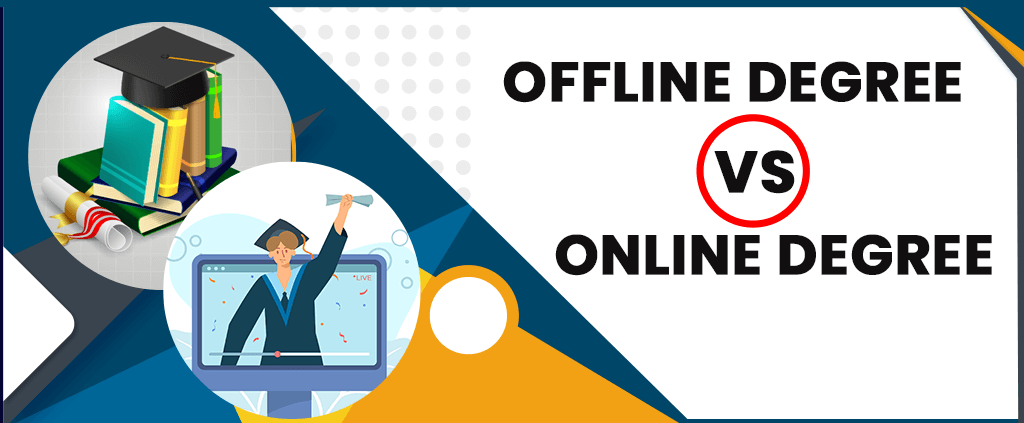
Online Degree V/S Offline Degree – Equal to Regular Degree?
- Yes, online/distance degrees are considered as equivalent to the offline regular degrees by both private and government organisations...
Yes, online/distance degrees are considered as equivalent to the offline regular degrees by both private and government organisations...…
Is Online Degree Equal to Regular Degree?
Yes, a degree obtained through the online/distance mode is equivalent to a degree obtained through the regular mode. Well of course there are many differences between the two but that does not affect the validity of the online/distance degree. The degrees obtained through the online/distance mode are as authentic as the regular ones and make you eligible for jobs or higher education in both government and private sector. However, the only requirement is that the college you pursue your online/distance degree must be recognised by the University Grants Commission (UGC) which is a statutory body that has been set up by the Ministry of Education (MoE) of India. The college must also be recognised by the Distance Education Bureau (DEB), a bureau of UGC which is specifically in charge of distance/online education in India. Of course, there are numerous differences between the two modes of education such as in the distance and online mode, you do not get hands-on practical training because everything happens virtually. However, all these differences are irrelevant as the validity of the degree stands the same. If you have an online/distance degree, then chances are that you will face situations where an applicant with an offline degree will be preferred over you. This is because the traditional and offline degrees are considered to be better but at the same time, the recruiters do not have the right to disqualify you based on your online/distance degree. UGC in its notification has stated that all online/distance degrees offered by institutions recognized by DEB and UGC will be treated as equivalent to the regular and offline degrees. Now you must be thinking that online/distance degrees are not beneficial as people still believe offline degrees to be better. No that isn’t the case. Online/distance are not all that bad, in fact, in many cases, they are better than the regular ones. When it comes to domain-specific or skill-specific courses like blockchain, AI & ML, Cyber Security, etc, recruiters look for the skills and knowledge of the applicant in these particular subjects and not the degree that the candidate holds. However, there are hardly any offline courses that specifically teach a single specialisation. Not even the IITs have any courses dedicated to subjects such as data science, cyber security, AI & ML, blockchain, etc. This is where online courses are helpful. Many big companies such as Apple, EY, Google, etc have made graduation optional for candidates applying to their firms as they test the candidates solely based on their skills and knowledge. This was just a brief differentiation between the two modes of learning just to explain the fact that online/distance degrees are equivalent to offline ones. There are other major differences as well. Let us describe them in detail one by one.
Learning Mode
Learning mode is of course the biggest difference between the two modes of education. In the case of offline regular courses, you have to regularly go to college and attend physical classes and also maintain your attendance. You will be able to interact with the faculty as well as your peers face to face. In the case of the online mode of education, you do not have to go to college. The university gives you an online platform usually known as the Learning Management System (LMS) where all the classes are conducted, discussions take place, and the learning material is accessed. You can think of it as a virtual classroom. Everything happens just like in a regular college just in the online mode. There are e-libraries, online events, online alumni meets, webinars, and live interactive sessions with eminent personalities from all over the globe. In the case of open and distance education, the colleges send the learning material like books, case studies, research papers, etc at the home of each student. The students have to just give the exams for each semester.
Fee Structure
The fee structure is a lot more for offline courses than for online and distance courses. In the case of offline courses, since you have to go to college you have to pay for the infrastructure facilities offered by the college. In the case of online and distance courses, you do not have to pay for any infrastructure as you complete the entire course from your home. You even cut down on expenses such as traveling, accommodation (hostel/pg/flat), laboratories, etc. These factors greatly affect the fee structure and make online and distance courses a lot more affordable.
Pedagogy & Curriculum
The syllabus for a course in the offline mode and in the online/distance mode is almost the same. The syllabus and curriculum have to be the same so that the online/distance degree is equivalent to the offline degree. Just like in the offline mode, there are regular quizzes, tests, and assignments in the online mode as well. All these are remotely proctored and in online mode. There are regular doubt sessions as well through the discussion forums set up by the college which is usually present on the LMS. Apart from these, there are other events as well such as regular webinars, live chats with subject experts, and alumni meets to get an exposure of the career opportunities as well.
🎓 Unlock Up To 100% Merit Scholarships for 2026 Admissions
Apply via EduXTech Common Form & get direct counseling from top NAAC A++ Universities.